Australia is one of the world’s top study destinations and for Pakistani students, it offers something most countries don’t: a clear path from a student visa all the way to permanent residency. But getting there requires careful planning, the right university choice, and a visa application that stands up to scrutiny.
This guide covers everything you need to know about studying in Australia in 2026 — from choosing your university and understanding costs, to getting your student visa approved and planning your career after graduation. All information is updated for 2026.
Choosing the right university with a proven track record of visa approvals can transform your study abroad journey from uncertain to assured.
Why Choose Higher Education in Australia?
Choosing where to study abroad is one of the most important decisions a student can make. Australia consistently ranks among the top three study destinations globally and for good reasons that go beyond brand names and rankings.
1. World-Ranked Universities With Globally Recognized Degrees
Australia is home to seven of the world’s top 100 universities. Australian degrees are recognised by employers and academic institutions in over 190 countries. Whether you study IT in Melbourne, engineering in Sydney, or business in Brisbane, your qualification carries real international weight.
2. Generous Post-Study Work Rights
After completing your degree, Australia allows you to stay and work for 2 to 4 years through the Temporary Graduate Visa (Subclass 485) one of the most generous post-study work policies in the world. This work experience also builds your points toward permanent residency.
3. A Growing Pakistani Community
As of 2026, over 28,000 Pakistani students are enrolled in Australian institutions. Major cities like Melbourne, Sydney, and Brisbane have established Pakistani communities, halal restaurants, mosques, and cultural organizations making the transition to life abroad significantly easier.
4. Part-Time Work Rights During Study
Students on an Australian student visa can work up to 48 hours per fortnight during semester, and unlimited hours during university breaks. With minimum wages above AUD 23 per hour in most states, students can meaningfully contribute to their own living expenses.
5. A Transparent Pathway to Permanent Residency
Australia’s points-based immigration system is one of the most structured in the world. An Australian degree combined with local work experience creates a strong PR application something that is difficult to replicate with overseas qualifications alone.
What Is Go8 Australia?
The Group of Eight, commonly known as Go8, is a coalition of Australia’s eight leading research-intensive universities. Established in 1999, these universities consistently rank among the best in the world and are particularly known for their research output, industry partnerships, and graduate employability.
The eight member universities are:
- The University of Melbourne
- The Australian National University (ANU)
- The University of Sydney
- The University of Queensland
- Monash University
- The University of New South Wales (UNSW)
- The University of Western Australia
- The University of Adelaide
Admission Requirements in Australia
Australian universities maintain consistent baseline requirements for international students, though specific programmes may have additional criteria. Here is what you will generally need to prepare:
Academic Documents
- Certified copies of your academic transcripts and certificates (Intermediate, Bachelor’s, or Master’s depending on the level you are applying for)
- Verified mark sheets for all completed years of study
- Degree completion certificate or provisional certificate if recently graduated
Test | Typical Minimum Score Required |
IELTS Academic | 6.0 overall (no band below 5.5) for UG; 6.5 for PG |
PTE Academic | 50–58 for UG; 58–65 for PG |
TOEFL iBT | 72–79 for UG; 79–90 for PG |
Note: These are university admission requirements. The Department of Home Affairs (visa authority) has a separate minimum — typically IELTS 5.5 overall for Pakistani nationals at visa level.
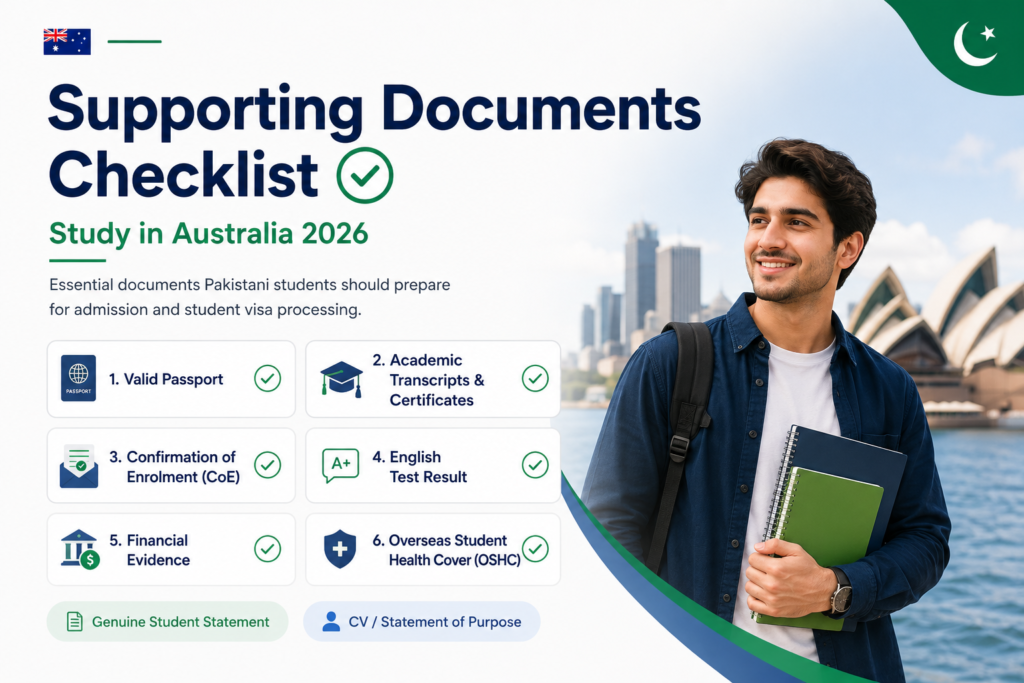
Australia study visa requirements for Pakistan involve both mandatory documents and strategic presentation. Applicants must secure admission and obtain their Confirmation of Enrollment. Financial evidence demonstrating capacity to cover tuition, living expenses, and travel costs becomes crucial. English language proficiency through PTE, IELTS, or TOEFL must meet minimum thresholds. Overseas Student Health Cover must be arranged for the entire study duration. Thorough preparation across all these requirements significantly enhances approval prospects.
Supporting Documents
- Valid Pakistani passport (must be valid for the entire duration of your course)
- Statement of Purpose (SOP) explaining your academic goals and why you chose this course and university
- Two or three academic or professional reference letters
- Updated CV or resume (required for postgraduate applications and some undergraduate programmes)
- Portfolio (required for design, architecture, or arts programmes)
- Bank statement demonstrating financial capacity (required at visa stage
Pro Tip: A well-written Statement of Purpose can significantly strengthen a borderline application. It should clearly connect your academic background, your reasons for choosing this specific programme in Australia, and your career plans after graduation. Generic SOPs are immediately recognisable — take time to personalise yours.
How Much Does It Cost to Study in Australia?
The cost of studying in Australia varies significantly depending on the university, city, and level of study. Below are realistic 2026 estimates to help you plan accurately.
Tuition Fees
Level of Study | Annual Tuition Fees (AUD) |
Undergraduate (Bachelor’s) | AUD 25,000 – 40,000 |
Postgraduate (Master’s) | AUD 28,000 – 45,000 |
Vocational / TAFE Diploma | AUD 8,000 – 20,000 |
PhD (Research Degree) | AUD 22,000 – 35,000 |
English Language Programme | AUD 300 – 350 per week |
Living Expenses
The Australian Government estimates the average cost of living for an international student at approximately AUD 21,000–27,000 per year, though this depends heavily on the city and your lifestyle.
Expense Category | Estimated Annual Cost (AUD) |
Rent (shared accommodation) | AUD 10,000 – 16,000 |
Food and groceries | AUD 4,000 – 6,500 |
Public transport | AUD 1,500 – 2,500 |
OSHC health insurance | AUD 500 – 700 |
Phone, internet, utilities | AUD 1,200 – 2,000 |
Books and study materials | AUD 500 – 1,500 |
Total Annual Estimate | AUD 17,700 – 29,200 |
City Tip: Sydney and Melbourne have the highest living costs in Australia. Brisbane, Adelaide, and Perth are noticeably more affordable — and studying in a regional area can also earn you additional points toward permanent residency.
Scholarships for International Students in Australia
Financial support is available for Pakistani students studying in Australia — but most scholarships require a separate application and early planning. Here are the most relevant options in 2026:
Australia Awards Scholarship
This is the Australian Government’s flagship scholarship for students from developing countries, including Pakistan. It covers full tuition, return airfare, living allowance, and health cover. Competition is high, but Pakistani students regularly receive this award. Applications typically open in April–May for the following year’s February intake. Visit the Australia Awards website for current eligibility criteria and deadlines.
Destination Australia Scholarship
Funded by the Australian Government specifically to encourage students to study in regional Australia. Awards of up to AUD 15,000 per year are available for international students at participating regional institutions. Studying regionally also adds PR points — making this a financially and strategically sound option.
University Merit Scholarships
Most Australian universities offer merit-based scholarships to high-achieving international students. Monash University, Griffith University, Western Sydney University, and the University of Adelaide have historically offered scholarships ranging from 10% to 50% tuition reduction for strong applicants. These are typically awarded automatically based on your academic profile at the time of admission, or through a separate scholarship application.
Research Scholarships (PhD and Masters by Research)
The Australian Government Research Training Programme (RTP) provides fee offsets and living stipends for students enrolled in research degrees at Australian universities. This is one of the most accessible forms of full funding for academically strong Pakistani students, as it does not require a separate competitive process — admission to a research programme is the primary requirement.
Scholarship Tip: Scholarship availability and amounts change annually. Always check directly on the university’s international scholarships page and the Australia Awards official website. Do not rely on third-party aggregator sites for current details.
Post-Study Work Opportunities
One of the most compelling reasons Pakistani students choose Australia is the post-study work pathway. After completing your degree, you can apply for a Temporary Graduate Visa (Subclass 485), which lets you live and work in Australia for a defined period.
Temporary Graduate Visa Duration by Degree
Degree Completed | PSW Visa Duration |
Bachelor’s Degree | 2 years |
Honours Degree | 2 years |
Master’s Degree (Coursework) | 3 years |
Master’s by Research | 4 years |
PhD (Doctoral Degree) | 4 years |
Regional Study Bonus | Additional 1–2 years on top of the above |
2026 Age Limit Update
From 2024, the Post-Higher Education Work stream of the Subclass 485 has an age cap of 35 years. However, graduates of a Master’s by Research or PhD programme are exempt from this restriction and can apply up to age 50. For students who are 35 or older, enrolling in a research-based degree is therefore a strategically important consideration.
Student Visa (Subclass 500)
The Australian Student Visa (Subclass 500) is the official visa that allows international students to study full-time at a registered Australian institution. Understanding the requirements — and preparing your application correctly — is essential.
Core Visa Requirements
Requirement | Details |
Confirmation of Enrolment (eCoE) | Must be enrolled full-time in a CRICOS-registered course |
Genuine Student (GS) Requirement | Must demonstrate genuine intent to study — replaces GTE from 2024 |
Financial Capacity | Minimum AUD 29,710 for living costs + tuition + travel |
English Proficiency | IELTS 5.5 minimum at visa level for Pakistani nationals |
OSHC Health Cover | Must be purchased before lodging visa application |
Health Examination | Required for Pakistani nationals — DIBP approved doctor |
Character Check | Police clearance certificate from Pakistan |
Valid Passport | Must cover the entire duration of your course |
The Genuine Student (GS) Requirement — Most Important
In 2024, Australia replaced the Genuine Temporary Entrant (GTE) requirement with a more structured Genuine Student (GS) assessment. Immigration officers evaluate whether you are genuinely coming to Australia to study — not simply as a pathway to migration.
Your GS statement should clearly address:
- Why you chose this specific course and institution
- How this qualification fits your academic and career trajectory
- What your plans are after completing your studies
- Your ties to Pakistan — family, financial interests, long-term career plans
⚠️ Important: Do not copy a GS statement from a template or another student. Immigration officers are trained to identify generic responses. A weak or copied GS statement is one of the most common reasons for student visa refusals from Pakistan in 2026.
Step-by-Step Visa Application Process
- Receive offer letter and pay tuition deposit to get your eCoE from the university
- Purchase Overseas Student Health Cover (OSHC) from an approved provider
- Complete your medical examination with a DIBP-approved panel physician in Pakistan
- Obtain a police clearance certificate
- Create an ImmiAccount on immi.homeaffairs.gov.au
- Upload all documents and submit your visa application
- Pay the visa application fee (AUD 2,028 as of July 2025 — non-refundable)
- Await the decision — average processing time is 4–8 weeks in 2026
Common Reasons for Visa Rejection — And How to Avoid Them
Rejection Reason | How to Avoid It |
Weak or copied GS statement | Write a personal, specific statement explaining your individual situation |
Sudden bank deposits with no history | Maintain 3–6 months of consistent balance before applying |
Course does not match academic background | Explain the logical connection clearly in your SOP and GS statement |
Missing or incomplete documents | Create a checklist and verify every item before submission |
Insufficient English proficiency evidence | Ensure your test score meets both university and visa requirements |
Medical examination done too late | Book and complete your medical at least 3 weeks before applying |
Preparing for the Visa Interview
While Australian student visas typically process without interviews, officers may request additional information or clarifications. Prepare to explain your course choice, career plans, financial arrangements, and ties to Pakistan convincingly. Practice articulating your educational journey and how Australian studies advance your professional goals. Gather supporting documents addressing potential concerns proactively.
Post-Lodgement Steps
After submitting your visa application, check your ImmiAccount regularly for document requests or status changes. Respond promptly to any Department of Home Affairs requests for additional information. Avoid making international travel plans until receiving visa approval. Once approved, confirm your CoE remains valid, arrange accommodation, and book a free consultation with Midlands Consultants for pre-departure briefings covering banking and settlement essentials.
Schedule a Meeting With Us to Discuss Your Academic Endeavors
Every student’s situation is different your academic background, the course you want to study, your financial circumstances, and your long-term goals all affect which university and visa pathway is right for you.
At Midlands Consultants, our experienced advisors have helped hundreds of Pakistani students secure admissions and visa approvals for Australian universities. From selecting the right programme to preparing a strong visa application and GS statement, we guide you through every step so you can focus on what matters most: preparing for the journey ahead.
Book a free consultation with Midlands Consultants today and take the first step toward your Australian education.
Navigating Australian university applications and visa processes independently proves challenging for most Pakistani students. Expert consultants bring updated knowledge of changing regulations, university preferences, and visa requirements. They provide realistic assessments of admission chances based on individual profiles. Professional application preparation significantly improves acceptance rates at competitive universities.
Conclusion
Studying in Australia is one of the most rewarding decisions a Pakistani student can make but only when approached with the right information and proper planning. From choosing the right university and understanding your true costs, to building a strong visa application and thinking ahead about your career and PR pathway, every step matters.
Australia offers what few other destinations can: world-class education, generous post-study work rights, a welcoming Pakistani community, and a transparent route to permanent residency. The opportunity is real but so is the competition and the complexity of the process.
At Midlands Consultants, we have guided countless Pakistani students through every stage of this journey from their first university shortlist to their visa approval letter. We know what Australian institutions look for, what immigration officers assess, and how to present your profile in the strongest possible way.
If you are serious about studying in Australia in 2026 or 2027, do not leave your future to guesswork. Reach out to Midlands Consultants today for a free consultation and let us help you get there the right way.
Australia’s multicultural environment, quality education system, and post-study opportunities provide comprehensive value beyond degrees. Students from Lahore, Faisalabad, Sialkot, and Multan can confidently pursue Australian education knowing clear pathways exist.
Partnering with trusted consultants like Midlands Consultants ensures your application receives professional attention, maximizing approval chances throughout your journey.
How to apply for a study visa in Australia?
To apply for an Australian Student Visa (Subclass 500), you must first secure an offer of admission from a CRICOS-registered institution and receive your electronic Confirmation of Enrolment (eCoE). You will then need to purchase Overseas Student Health Cover (OSHC), complete a medical examination with a DIBP-approved doctor in Pakistan, and obtain a police clearance certificate. Once all documents are ready, create an ImmiAccount on the Department of Home Affairs website, complete the online application form, upload your documents, and pay the non-refundable application fee of AUD 2,028. Average processing time in 2026 is 4–8 weeks, though complex applications can take longer.
What are the requirements to study in Australia?
The core requirements for studying in Australia include: an offer letter and Confirmation of Enrolment (eCoE) from a registered Australian institution, a valid Pakistani passport, an Australian Student Visa (Subclass 500), proof of English language proficiency (IELTS, PTE, TOEFL, or equivalent), evidence of sufficient financial capacity to cover tuition and living costs, and Overseas Student Health Cover (OSHC). Academic documents including transcripts, certificates, and a Statement of Purpose are required for admission. Specific programmes may have additional requirements such as portfolios, work experience, or professional references.
What is the minimum bank balance required for an Australian student visa?
For 2026, the Department of Home Affairs requires you to demonstrate financial capacity covering the first year of your studies. This includes a minimum of AUD 29,710 for annual living expenses, your first year's tuition fees (typically AUD 25,000–45,000 depending on your course), and approximately AUD 2,000–2,500 for return travel. In total, Pakistani applicants generally need to show a combined balance of AUD 55,000–75,000, which translates to approximately PKR 10–14 million at current exchange rates. This amount can be shown in the student's own account or a sponsor's account, but must reflect a consistent balance history of at least 3–6 months recent large deposits without a clear source are a common reason for visa rejection.
Which universities in Australia are best for Pakistani students?
The universities that consistently receive the highest number of Pakistani applicants and have strong track records of admission and visa approvals include: Monash University (QS #36) for its accessible admissions process and strong scholarship programme; the University of Melbourne (QS #19) for Business, Law, and Medicine; UNSW Sydney for Engineering and Technology; the University of Queensland (QS #42) for Business and Environmental Sciences; RMIT University for IT, Design, and Engineering; and Western Sydney University for students seeking a more affordable entry point with flexible admission requirements. For students with strong academic records, Go8 universities offer excellent graduate outcomes and research opportunities.
How much study gap is acceptable in Australia?
study gaps. A gap of up to two years is generally considered acceptable for undergraduate admissions, while postgraduate applications allow for longer gaps, particularly when the intervening time was spent in relevant professional work. What matters most is that you can explain your gap honestly and logically — whether through employment, family responsibilities, health reasons, or further training. Your Statement of Purpose and Genuine Student statement are where this explanation belongs. Unexplained or poorly justified gaps are more likely to raise concerns during the visa assessment.
Can I work while studying in Australia?
Yes. International students on an Australian Student Visa (Subclass 500) are permitted to work up to 48 hours per fortnight (14-day period starting Monday) while their course is in session. During official university breaks, there is no restriction on working hours. This applies to any type of employment — part-time, casual, or contract work. With minimum wages above AUD 23 per hour in 2026, even part-time work can meaningfully offset living costs. Note that breaching your work hour limit is a visa condition violation and can have serious consequences for your stay.
How much does it cost to study in Australia from Pakistan?
The total cost of studying in Australia from Pakistan depends on your course, university, and city of study. As a general guide: tuition fees range from AUD 25,000 to AUD 45,000 per year for undergraduate and postgraduate programmes. Living costs add approximately AUD 18,000–27,000 per year, with Sydney and Melbourne at the higher end and cities like Adelaide, Brisbane, and Perth being more affordable. Additional one-time costs include the visa application fee (AUD 2,028), OSHC health insurance (AUD 500–700 per year), medical examination (approximately PKR 15,000–20,000 in Pakistan), and English test fees (approximately PKR 55,000–60,000). Over a typical three-year degree, Pakistani students should budget for a total expenditure of AUD 130,000–220,000, partially offset by part-time income earned during study.
What IELTS or PTE score is required for an Australian student visa?
There are two separate English requirements to understand. For the Student Visa (Subclass 500) itself, the Department of Home Affairs requires a minimum of IELTS 5.5 overall (or equivalent PTE score of 42) for Pakistani nationals — this is the visa-level requirement. For university admission, requirements are higher: most undergraduate programmes require IELTS 6.0 overall with no band below 5.5, while postgraduate programmes typically require IELTS 6.5 with no band below 6.0. PTE Academic equivalents are 50–58 for undergraduate and 58–65 for postgraduate admission. Your university's offer letter confirming that your English proficiency meets their threshold is what the immigration officer primarily assesses during visa processing.